
The Iowa Arrest Log Has Layers
What counts as an arrest log in Iowa depends on the record behind it. A sheriff's blotter is one thing. A booking roster is another. The State Patrol issues press releases, and a news story gives a reported narrative, not a complete list of arrests. A roster shows who was in custody at a point in time. An activity log may list calls and incidents that never led to a booking. The formats overlap, but they answer different questions.
Start with the event you need to check. Then read the window and the source label. A multi-day source helps when a one-day view has rolled forward, or when a weekly outlet has gathered several days into one issue. The Iowa 24-hour arrest view handles same-day routing; multi-day arrest-log work follows publication cycles, archive depth, and dated records.
County Arrest Logs Across Iowa
County publication habits differ across Iowa. Woodbury County posts a dated activity log. Allamakee County relies on weekly sheriff dispatch and jail-intake reporting. Cass County publishes dated roster PDFs that combine booking and release information. Each covers a different time span. Use the County Directory to reach the sheriff or jail source tied to the event, then check whether the record shows a booking, a custody list, or an incident report. Field names vary. Read a multi-day entry on its own terms rather than assuming every Iowa county publishes the same fields.
| Source type | Window and visible detail | What it does not establish |
|---|---|---|
| Woodbury Daily Sheriff Activity Log | Date selector and Daily, Activity Summary, and Street Summary reports; reviewed rows showed incident date and time, activity, location, and an “as of” time. | It is an incident and activity log, not a booking-photo gallery or complete arrest list. |
| Allamakee weekly intake reporting | Issue window can range from days to weeks, based on the local weekly publication cycle. | The issue date is not a guaranteed booking timestamp. |
| Cass dated roster PDF | A dated snapshot combines booked and released reporting. | It is not necessarily a rolling archive or complete historical roster. |
| State Patrol press release | Selected incidents and enforcement results, published when DPS chooses to issue a release. | It is not a daily statewide patrol log or a complete list of arrests. |
| Local news blotter or story | Incident narrative follows an outlet's reporting and issue schedule. | It is not an official jail record, and its coverage is selective. |
Not every roster shows booking photos. Some omit them, and others lack a photo field. Read a multi-day log for its stated purpose and its fields, not for whether it looks like a mugshot roster.
Woodbury's Dated Activity Reports
Woodbury County's Daily Sheriff Activity Log is a clear example of an archive-style public log. The interface suits date-by-date browsing. It offers a date selector plus Daily, Activity Summary, and Street Summary report choices. Rows carry an incident date and time. The activity, the location, and an "as of" timestamp complete each line. History reaches roughly 90 days back. Live depth can vary. Dated rows help trace activity across days. An activity line alone, though, does not show that someone was arrested or booked.
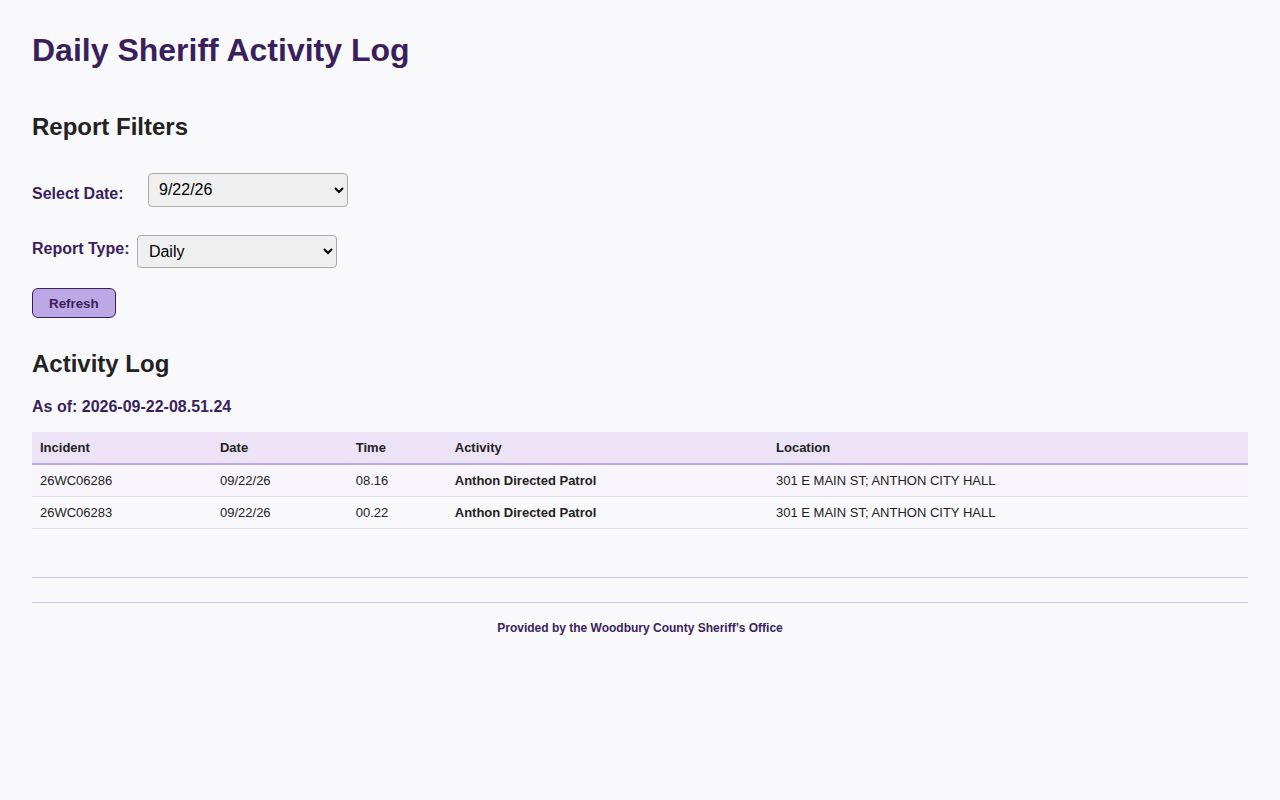
Read an activity report for its incident fields. For custody, check the jail's current source or its records custodian. A stop can end without an arrest.
Iowa State Patrol Releases Are Selective
The Iowa Department of Public Safety press-release archive is the statewide multi-day source. It carries year and division filters. Release pages hold up over time. Items mix Iowa State Patrol news with reports from other DPS divisions. A release may include a date, headline, incident narrative, agency contact, and selected charge or custody details. The feed is event driven. The Patrol publishes no official daily arrest or dispatch log.
Enforcement campaign stories can describe a broad operation without naming each person arrested. A case release may state where someone was booked. County custody records still hold the later status. Iowa 511 covers roads, not arrests. For the Patrol's reports and booking handoff, see the Iowa State Patrol arrests information.
Iowa News Blotters Have Their Own Clock
News coverage can help you find a reported incident. Still, a story list is not a booking system. Regional outlets include Raccoon Valley Radio and the Creston News Advertiser. Statewide reporting includes the Iowa Capital Dispatch. Each outlet picks its own stories and follows its own cycle, so none works as a complete statewide roster.
The Waukon Standard's top-stories page shows how issue timing shapes what a local reader sees. That page is a publication channel. It does not display booking photos. Treat any jail-intake story as secondary reporting, keep its publication date, and confirm charges or case status with the official custodian or court.

An arrest story may run without a booking date or any later disposition. Headlines can change too. A court result may appear after publication. When requesting a correction, point to the exact story claim and an official record, since an accurate historical story is not the same as an incorrect roster entry.
Weekend and Holiday Posts Can Lag
A quiet log does not always mean a quiet jail. Weekend and holiday gaps reflect publication habits, not arrest trends. A jail roster refreshes on its own cadence. A weekly paper may bundle several days into one issue date. State Patrol enforcement news sometimes lands days after an operation wraps. Court dockets add later events on yet another clock. Track four dates separately. Note the event, the booking, the report period, and the day the record went public.
Need a brand-new booking? Start with the county roster or its records contact listed in the Iowa County Directory. A multi-day source stuck on an old date calls for a different move. Check an official archive. Or ask the agency directly whether it keeps a record series past what its website shows. The same-day Iowa arrest sources answer who was arrested now. They say nothing about what an older blotter once covered.
Older Iowa Arrest Logs and Archives
An arrest log can vanish from a website. That does not mean the record was destroyed. Iowa Chapter 22 opens the door to records. Yet it sets no single lifespan for a sheriff's roster, booking photo, or activity log. Retention follows the record series and its approved schedule. The State's records manual and schedule spells this out. Records marked permanent may transfer into the legal custody of the State Archivist. Others can be disposed of under their schedule. A page can go dark while an agency record survives.
For historical government records, begin at the Iowa State Archives collections portal. Record Group 075 holds State Patrol history and Department of Public Safety material. The portal page shows archive collections, not a live county booking search.
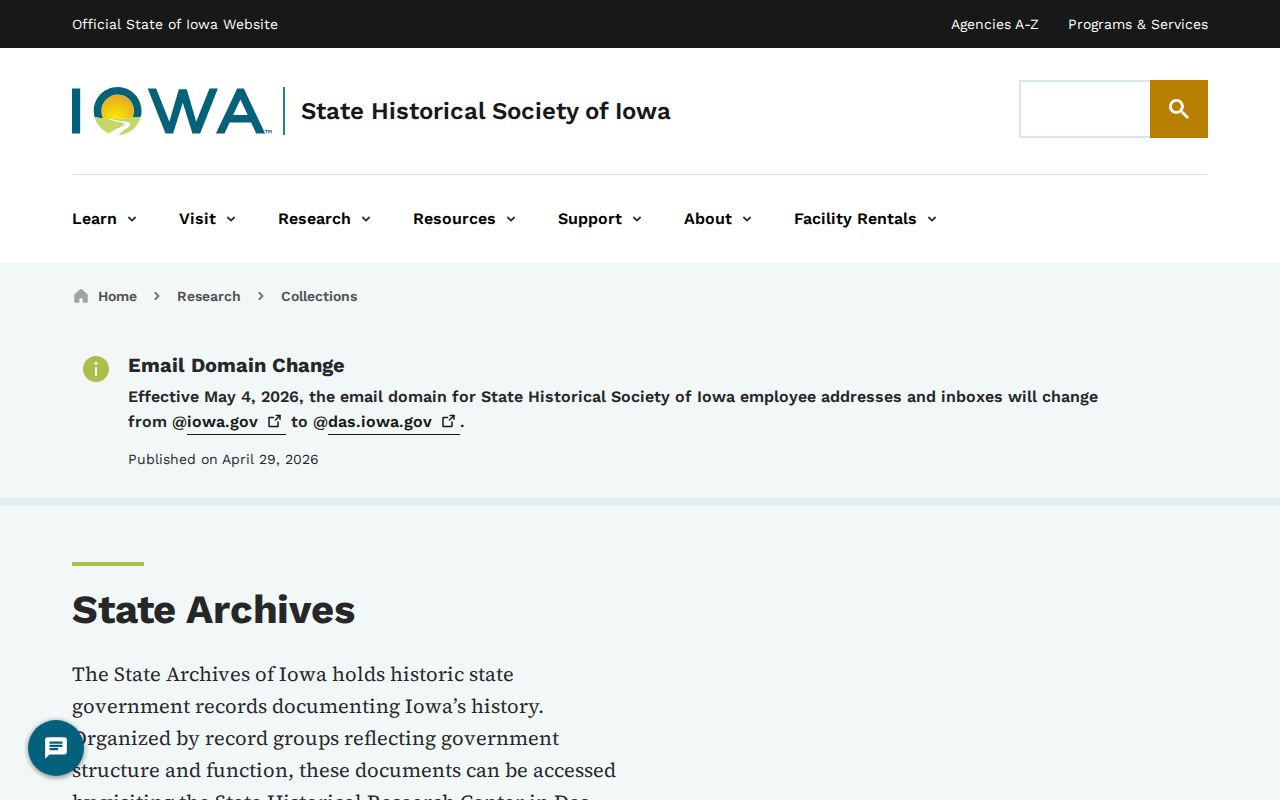
The archive landing page maps record groups. It is not a live arrest feed.
Record Group 097 covers prison and reformatory registers, indexes, inmate reports, and institutional photographs. Governor records add life-inmate files, criminal-record series, and pardon or parole material. These trails track state custody over time. They are not complete archives of every modern county arrest.
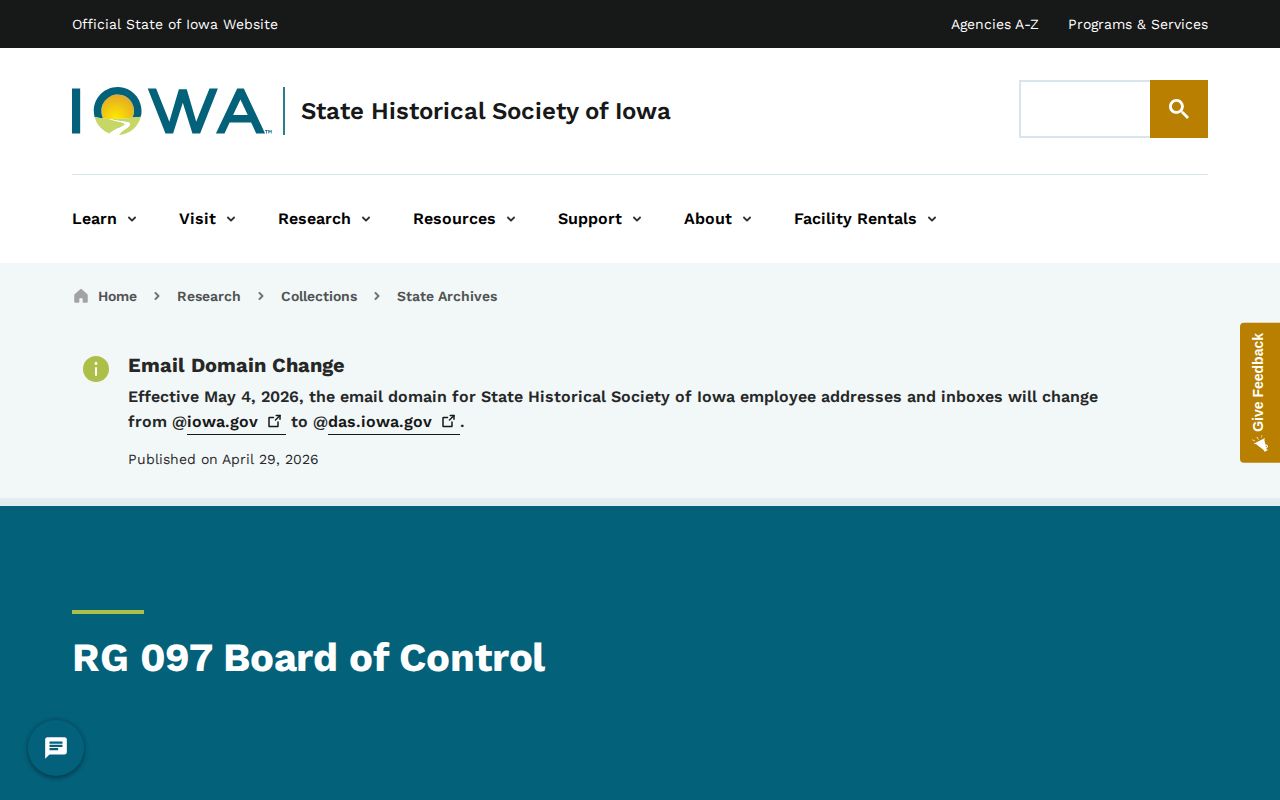
This register index is historical. It is no substitute for a modern county arrest feed.
The State Historical Society's digitization partnership notice describes Iowa State Prison convict registers, historic Bertillon identification cards, and mug shots. The notice itself is just a collection announcement. A partner interface may carry its own account, subscription, or image-use terms. Check the current access conditions before relying on it.

Historical collections run deepest for state institutions and old custody records. For an older county sheriff entry, go local. Ask that county's clerk, sheriff, or local archive whether a record series exists and remains open.
Request Records Beyond the Log Window
A well-aimed request can surface a record that no longer sits in a web log. Under Iowa Code Chapter 22, send the request to the government body holding the record. Name the record you want. The agency has no duty to build a new report. It also need not answer an undocumented question. Ask the custodian whether the booking register stands as a separate record. Do this for the incident report, activity log, or photo. Also ask which parts are confidential.
- Identify the county or agency and the likely record holder. For State Archives material, use its collection finding aid and name the record group or series when known.
- Give the person's name, approximate date, county or institution, event, and report number if available. State whether you need a copy, certified copy, or research help.
- Ask for the estimated fee, search time, expected schedule, and any redactions, meaning parts withheld from a copy for legal reasons. Request the legal basis if a record is withheld.
- For archive copies, check the current State Historical Research Center fee and image-request rules before ordering.
The archive request page lists example charges of 25 cents for an 8.5-by-11-inch copy, 50 cents for an 8.5-by-14 or 11-by-17 copy, and $2.75 for a certified State Archives photocopy. Extra volume, research, high-resolution, or special-use work can have different terms. Confirm current fees and turnaround with the research center. Permanent retention does not remove a privacy restriction, and old web visibility does not guarantee an archival copy exists.
For a current booking or incident record, use the local county custodian rather than sending a historical request to the State Archives. Iowa Courts Online can help check case events. A disposition is the court's recorded result, such as a dismissal, plea, or judgment. The Iowa public-records law overview explains access limits and court-record follow-up.