
Iowa Arrests Across County Feeds
Iowa has no single statewide booking roster. Every sheriff and jail publishes its own view of arrests. Some run a live custody list, others post dated reports or an app. A few offer no public web list at all. A current-inmate page tells you who appears to be held now. It does not tell you who was arrested today. People get booked, released, or moved before anyone checks. A court case can stay searchable long after the person leaves jail.
County systems differ sharply across Iowa. Scott County's official inmate page blends a dynamic roster with current inmates and a seven-day release history. It refreshes about every ten minutes. Worth County takes another path. Its official jail page uses a Power BI view. It covers active inmates and recently released records over a 30-day window. Elsewhere, counties post dated roster PDFs or push an app as the main channel. Many rural counties publish no official 24- or 48-hour feed at all. Some pages show a mugshot. Some show only a name and status. Some have no roster whatsoever. These are publication choices, not evidence that the underlying record differs.
None of these examples describe the whole state. They are simply different local systems doing the same job in different ways. To search well, learn the county system's date fields and update notes first. Then ask the right question. Is it a fresh booking, current custody, or a case outcome you need? A roster window does not set the record's legal retention period either. The answer shapes which page you trust.
Find the Iowa Booking County
Start where the arrest happened. The person's home county matters less than the booking location. So does the agency that made the stop. A county sheriff may hold a city arrest, a state-patrol arrest, or someone brought in under a local agreement. That booking spot is your best clue for a roster search. A news release naming the receiving jail? Use that county first. If the location is unclear, call the arresting agency and ask who took custody.
The Iowa County Directory routes you to each local county site. Open the sheriff or jail link there. Then check whether the page covers people currently held, recent bookings, or releases. Silence on one site never proves an arrest did not happen. The jail may post no public roster. The record may still be under review, or the person may already be out. For an urgent safety question, call the agency directly.
- Identify the Iowa county tied to the arrest scene or the receiving jail.
- Use the county's own link and note the page's window, update time, and search fields.
- If the roster does not answer the custody question, call the jail or records custodian.
- Use the court docket later to check the case outcome, not to guess from a booking charge.
A county page may link to city agencies. It may also explain which towns rely on the sheriff for bookings. That detail helps route a local arrest to the right record holder. But a city name alone tells you nothing about which jail received the person. Confirm the facility with an official source. Never treat a single search result as a match.
Check Iowa Arrests Today
A same-day search asks a simple question. Does this county show bookings made today, or only within a stated recent window? Iowa interfaces share no clock and no common refresh rule. A dynamic roster may update hourly while a PDF sits for a week. A page labeled current inmates can include people booked days ago. It may also miss those already released. Trust the date on the record and the date range you selected. Note any "as of" time the county displays too.
| Search need | Best statewide route | What to verify |
|---|---|---|
| Who was booked recently | Open the arrest county's newest-booking or same-day view. | Its actual time window, posting lag, and date field. |
| Who remains in custody | Check the live county roster or call the jail. | Current status and receiving facility. |
| One known person's custody | Use IowaVINE through VINELink where the record is connected. | A fresh booking can take time to appear. |
| Several days of activity | Use an agency log, dated roster, or news blotter. | Whether the entry describes an incident, booking, or article. |
For statewide depth, 24 Hour Arrests maps the same-day landscape, while the Iowa Arrest Log covers multi-day logs, stories, and archives. The two windows answer different questions. A recent booking record can linger after release, even when the roster drops the name. When timing matters, call the jail.
Note: A search date may be the report date, upload date, booking date, or incident date, so compare the field labels before drawing a timeline.
Where Iowa Arrest Reports Appear
Match the tool to the question you're asking. County rosters answer who's in local custody. The Iowa State Patrol newsroom posts selective arrest stories, not a full log. Iowa Courts Online handles the case file once charges move forward. News coverage adds detail but never replaces a jail database. Third-party pages sit furthest from the record custodian, so counties go missing, names get doubled up, and old booking details linger long after the facts changed.
| Source | Record role | How to read it |
|---|---|---|
| County sheriff or jail | Booking, current custody, and a local roster or feed. | Official for the county's own records; posting differs by county. |
| Iowa State Patrol | Selected enforcement releases and arrest news. | Not a complete daily statewide arrest list. |
| Iowa Courts Online | Public case events and disposition entries. | A court case is not a jail roster or live warrant confirmation. |
| News and radio coverage | Stories about selected public-safety events. | Use the article date and request a documented correction if needed. |
| Third-party state indexes | Unofficial copies or links to some local public material. | Check the originating county or court before relying on a detail. |
RecentlyBooked's Iowa state section is a partial, county-by-county index, not a mirror of every county system. Its state navigation page is unofficial. Treat it as a lead, then confirm any arrest record with the local custodian.
The state landing page can point you toward a county section, but coverage and refresh times differ widely from one county to the next. The Busted Newspaper Iowa section and Arrests.org's Iowa index work the same way. Both are commercial pages with partial county coverage, not statewide jail records. They can help you spot a source worth checking. For a correction or current custody status, though, the sheriff, jail, or court that created the record remains the authority.
Iowa Wanted Lists and Warrants
There is no single "most wanted" list for Iowa. The public Iowa Sex Offender Registry Most Wanted page covers one slice: registrants who are noncompliant or on the run. It does not list every Iowa warrant. It does not track every recent arrest either. The Iowa Department of Public Safety's IOWA System holds wanted and missing-person data for law enforcement use, and the public cannot search it. The Iowa DOC news archive posts escape and work-release notices when the department chooses, each with its own dates and contact directions. The U.S. Marshals Service Northern District of Iowa page profiles selected fugitives and offers a 24-hour tip route. Federal task-force releases describe chosen operations, not every open warrant. A warrant entry on a docket is still not a statewide confirmation. Iowa exposes no complete public active-warrant search. For a specific concern, contact the court clerk or law enforcement through an official channel, or seek legal counsel. Never approach, follow, or threaten anyone shown on a wanted page.
The official registry's public wanted page appears below. It offers the registry's own list and tip route. It is not permission to investigate anyone yourself.
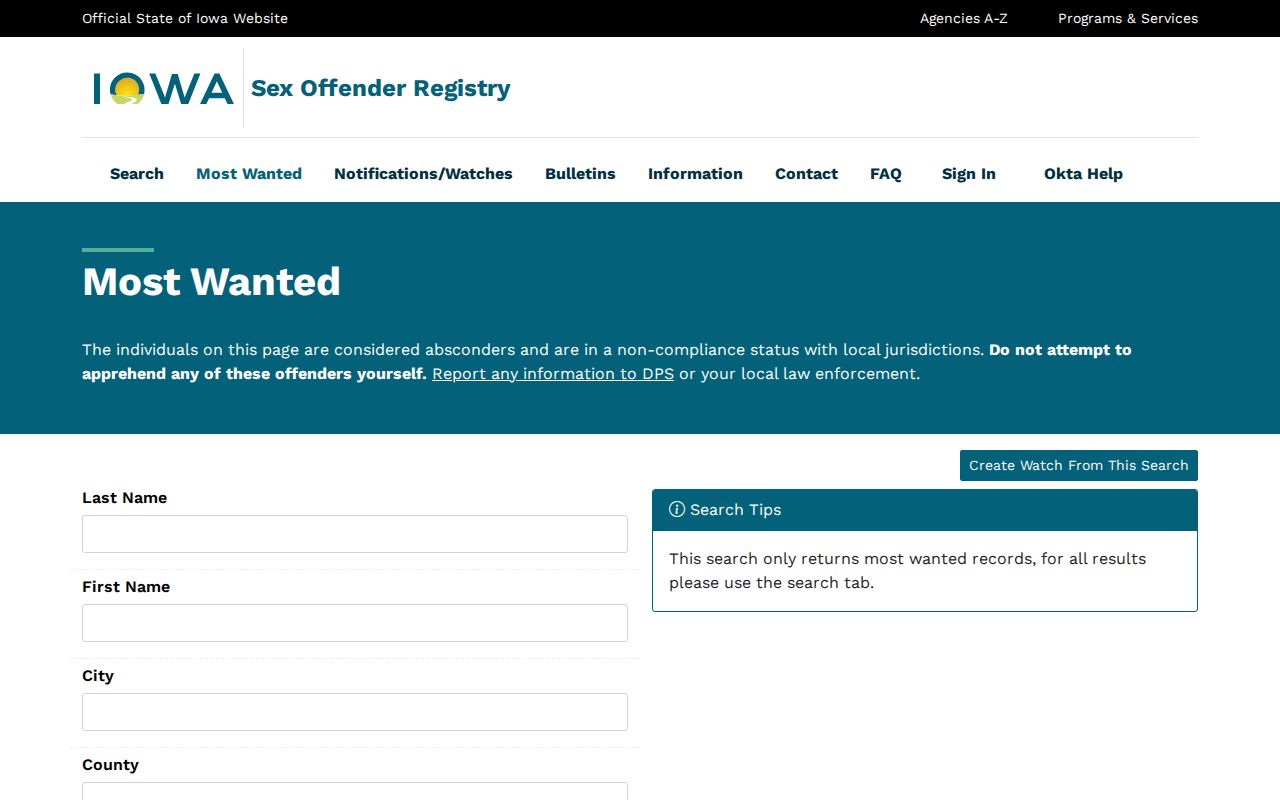
Seen something about a wanted person? Follow the agency's listed instructions. Call 911 if danger is immediate. Profiles can go stale, so let the agency confirm identity and status.
Safety: Never try to serve a warrant, chase a fugitive, or confront anyone. Use the official tip line, or call 911 when someone faces immediate danger.
Iowa Booking Records and Photos
A booking record starts with intake right after an arrest. What it holds depends on the custodian and the system. It may list a name, booking or arrest number, and the date and time. Arresting agency, reported charges, and bond can appear too. So can a court date and a booking photo. A roster often shows only some of that. Iowa guarantees neither full public fields nor a complete web page. A formal record request can reach material left off the online view. Confidentiality review and redaction still apply.
| Record field | What it can show |
|---|---|
| Name, age, and residence | Identity details shown in selected public rosters, such as Worth County's reviewed view. |
| Booking date, number, and agency | The intake date, arrest number, and agency reported by the local custodian; a later posting date may differ. |
| Charge and bond | An charge recorded at intake and any bond amount shown by that system. |
| Custody status and facility | Whether the person is listed as held, released, or transferred when the page was refreshed. |
| Photo and court date | An image if the agency publishes one, and a scheduled court event if included. |
| DOC profile | A separate state custody or supervision entry, not a county booking record. |
Booking fields change as a case moves. "Charge as booked" is not a final outcome. The docket may later show amendments, dismissal, acquittal, or judgment.
Note: Online fields are a display choice, so request a named record from the custodian when the public roster omits a detail.
- Booking
- The intake process that records a person's entry into a local jail after arrest.
- Bond
- A court-set release condition or amount; it is not a finding that a charge is true.
- Disposition
- The court's recorded outcome for a case or charge.
- Expungement
- A court-ordered change in access to an eligible record under Iowa law.
Request an Iowa Arrest Record
Want a county booking record or booking photo? Send a clear request to the sheriff, jail, or arresting agency that holds it. Iowa Chapter 22 gives the public the right to examine, copy, and share government records unless a specific exception applies. You can request in person, in writing, by phone, or electronically. No reason is required. The agency also has limits. It need not create a record that never existed, and it doesn't have to keep a web roster online for any fixed period.
- Name the county agency and describe the record, person or incident, and approximate date.
- Ask for the booking record, photo, and any public release or custody entry as separate record types.
- State a preferred format and ask for an estimate of search time, copy costs, and likely timing.
- If material is withheld, ask for the specific legal basis and any segregable nonconfidential portion.
Iowa treats its arrest records as public without much ceremony. Under the Iowa Chapter 22 text, you never have to explain why you want a record. The Iowa Public Information Board's overview makes the same point. Fees stay modest. The first 30 minutes of search time are usually free, and you pay copying or direct costs beyond that.
One agency sets its own terms. The Department of Public Safety's open-records policy waives the first three labor hours and three attorney hours. After that, hourly charges kick in. An estimate over $250 can trigger a request for advance payment. Remember, that schedule belongs to DPS alone. Your local Iowa sheriff may charge differently.
Prison and supervision files follow a separate path. Use the Iowa DOC open-records request route for those. The offender search covers state custody, not county bookings. When you write, name the person, give an approximate date, and ask for any nonconfidential portion an agency might otherwise withhold.
Retention runs on its own clock, too. A jail roster can roll off a website while the booking record itself survives under an approved record series. Iowa's Department of Inspections, Appeals, and Licensing lays this out in its records manual, since retention varies by record type. Ask the custodian which schedule applies to an old file. For deeper access rules and expungement details, see Are Arrest Records Public?
Iowa Mugshots and Photo Policy
Booking photos are a county-by-county matter in Iowa. Nothing in the public-record law forces a sheriff to post a mugshot. Some counties show a selected image. Others list only names and status, flag a photo as unavailable, or skip the roster entirely. Want a copy? Ask the record custodian directly. An unposted photo may still exist, and one county's display choice never binds the rest of the state.
Third-party sites are a different animal. Mugshots.com's Iowa index is an unofficial navigation page, not a government record. Its state index links outward rather than showing individual faces.
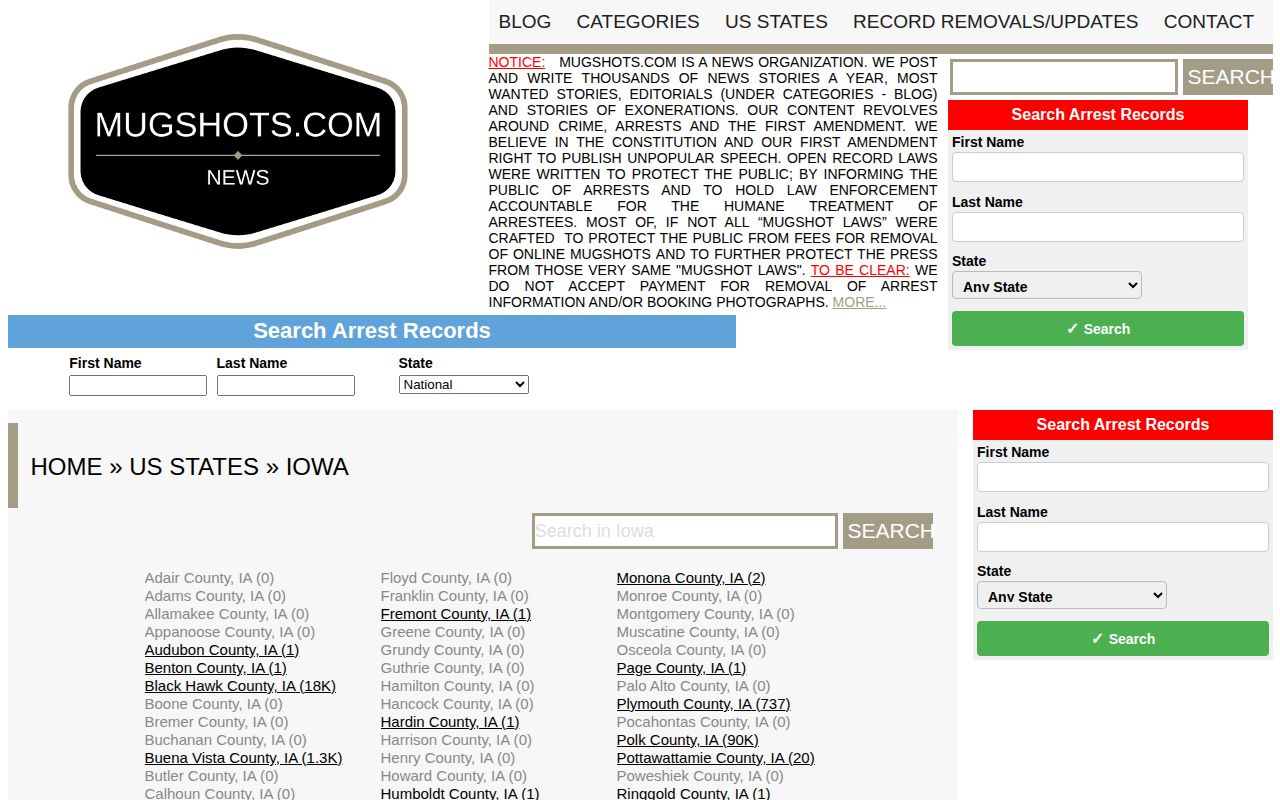
Aggregator links can be stale or incomplete. The source material may have already changed. So confirm any name, charge, date, or custody status with the county or court. Mugshots.zone's partial Iowa navigation offers another third-party discovery path. Its index view is not a photo gallery. It proves nothing about county coverage.
A mugshot can linger on a third-party page. The official roster may have moved on long before. That copy is secondary at best. Do not lean on it for identity or any legal conclusion. For the rules that govern the Iowa arrest-record law page, the state lays out free correction options there. It also explains the limits of private removal requests.
Iowa Mugshot and Arrest-Record Law
Iowa keeps its public-record rules in Chapter 22. The law casts a wide net over government records. Still, exceptions can shield part or all of a file. A sheriff's booking photo is not guaranteed a spot online. An online roster is not a promise that the same arrest details will be released to every requester. The custodian reviews the record and applies any exemption. A public portion may then be released with protected information redacted.
Iowa has no enacted mugshot statute aimed at private websites. Nothing bars a private site from publishing a booking photograph. Nothing forces removal on a set schedule. Nothing prohibits a fee for taking it down. House File 2309 tried to change that with a confidentiality rule and listed exceptions. It never became law. Treat it as an introduced bill, not an Iowa mugshot statute. For the full rule, legislative context, and access limits, see Are Arrest Records Public?
Juvenile records travel a separate road. Iowa Code Chapter 232 shields juvenile court and social records from ordinary public disclosure. Its own exceptions and court orders still apply. An adult roster practice gives no blanket right to post a child's name or booking photo. Investigative files, victim or witness details, and medical material can also be withheld under a specific law or order.
Expungement in Iowa follows distinct paths. Under Iowa Code Section 901C.1 and Section 901C.2, qualifying acquittals and dismissals can become eligible once required conditions are met. The general wait is 180 days. Good cause can support earlier action. Section 901C.3 handles certain misdemeanor convictions separately. It requires more than eight years plus other conditions. Exclusions such as OWI apply. A court order can change access to official court and repository records. It does not automatically delete a newspaper story, search result, jail copy, or private copy.
The DCI repository has its own retention rules. Historical records are generally kept to age 80 or death. An arrest lacking a disposition must be purged after four years under the repository rule. A public waiver search can also omit arrests older than 18 months when they lack a disposition. These are repository rules, not an automatic deletion clock for every county website.
Private publishers post their own correction policies. Busted Newspaper's listing form asks for the exact page plus legal documentation. Qualifying requests may take five to ten days. RecentlyBooked's policy states that qualifying updates carry no fee. Mugshots.com's record-maintenance policy calls its process free and gives a target of about ten business days. Arrests.org's live Iowa pages may show a removal link, but the site publishes no general free Iowa policy. Mugshots.zone's removal form exists, though its fee and timing are not stated. These are private policies, not rights Iowa law created.
Keep any correction request factual. Use the exact URL. Identify the error plainly. Attach the court order or official disposition when one exists. No private request guarantees that a live source or search result will vanish. Work through the originating custodian, the court, and each publisher's stated free route rather than paying an unknown publisher.
Note: An expungement order changes access under its terms, but the record holder and private copy may follow separate update steps.
After Booking: Iowa Courts and Custody
A jail roster and a court docket answer different questions. The roster shows who was booked. The court record picks up the story after that. It covers first appearance, hearings, amended charges, release terms, and eventual disposition. Check public case entries through Iowa Courts Online. Access limits apply, and a confidential record may not appear to every visitor.
After booking, the case belongs to the courtroom. The court's own docket is where any real outcome takes shape.
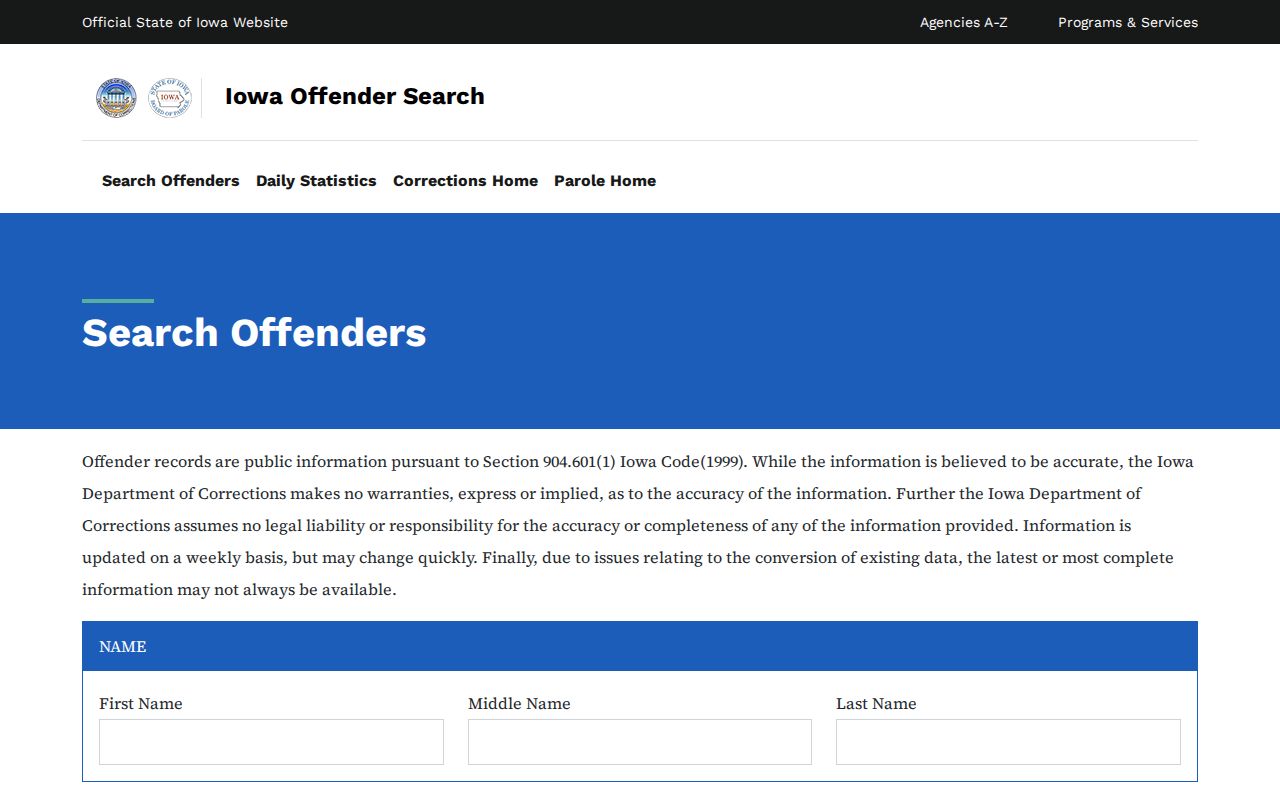
State custody calls for a different tool. Use the Iowa Department of Corrections Offender Search when a sentence or supervision places someone in state hands. It is updated weekly and can shift fast. Data-conversion issues leave it incomplete at times. Its profile is a custody or supervision record, not a county booking entry, and the public search does not promise a photo field.
The DOC search form displays its own search fields rather than a gallery of people.
Federal custody runs on separate systems. The Federal Bureau of Prisons locator covers federal inmates from 1982 forward, with daily updates. It excludes county and state inmates and offers no public booking-photo field. Its federal-only search page appears on the official site.
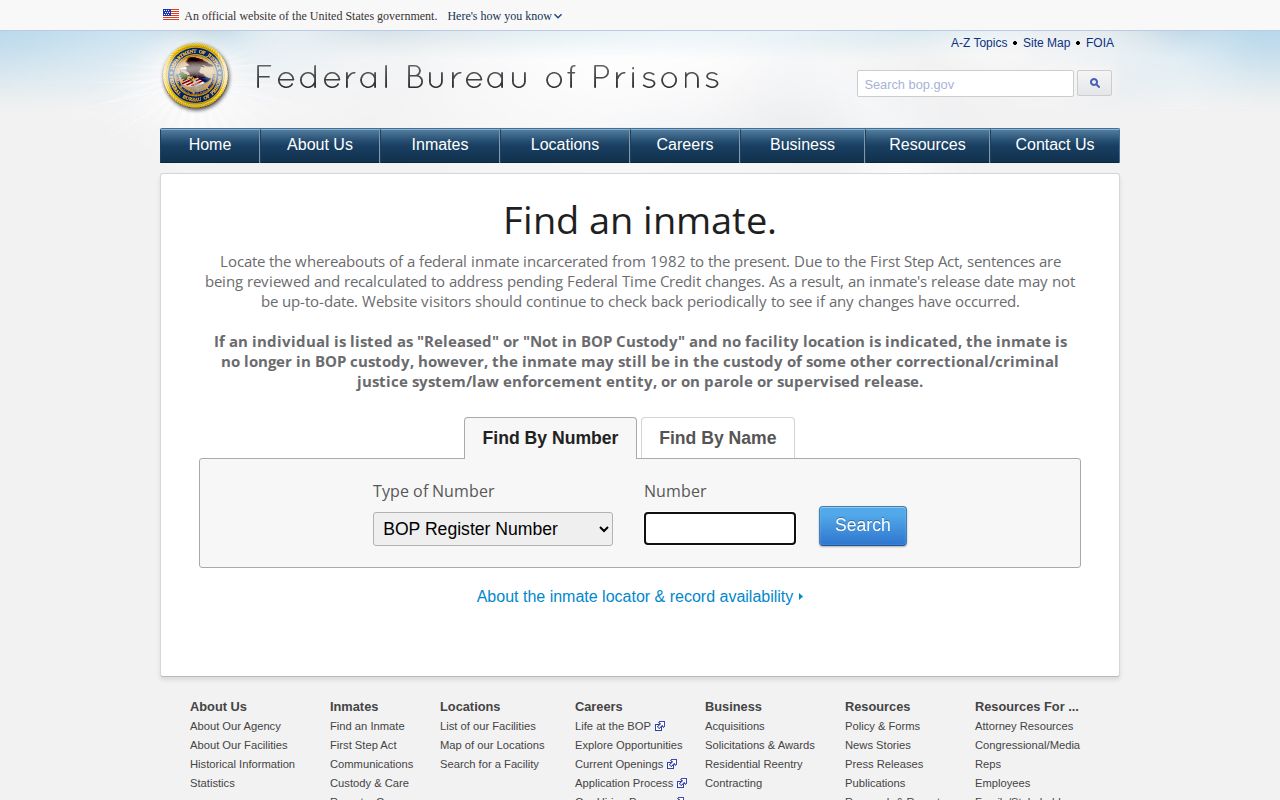
The BOP locator does not reach every federal detention stage. Someone in ICE custody may sit in a different system. The separate ICE detainee locator relies on identity fields. It warns that a new custody record may not appear at once. Neither federal search works as an Iowa county arrest roster.
Older Iowa Arrest and Prison Records
Long web visibility and legal retention are two different things. Chapter 22 sets no single statewide period for sheriffs' rosters, booking photos, or activity logs. A jail calendar sits in one record series. An arrest report may sit in another. The same goes for a booking register, a photo, or an exported app file. Ask the custodian which schedule governs the item rather than reading an old page as proof of retention.
The State Archives do keep selected historic public-safety and correctional records. Its collections page opens the door to finding aids and research access.
Old prison registers can trace an arrest trail that a modern county roster never held. A digitization notice from the State Historical Society covers Iowa State Prison convict registers and Bertillon cards. That archive history is separate from any current county booking page.

Collections like these help with old state-prison history. They are not a full record of every Iowa arrest in each county. For multi-day activity and archival sources, see the Iowa Arrest Log.
Note: Archives can preserve a record without making every image open to unrestricted use or public view.